
Improve Google Ads ROAS in 2026: The Ultimate Guide to Profitable Growth
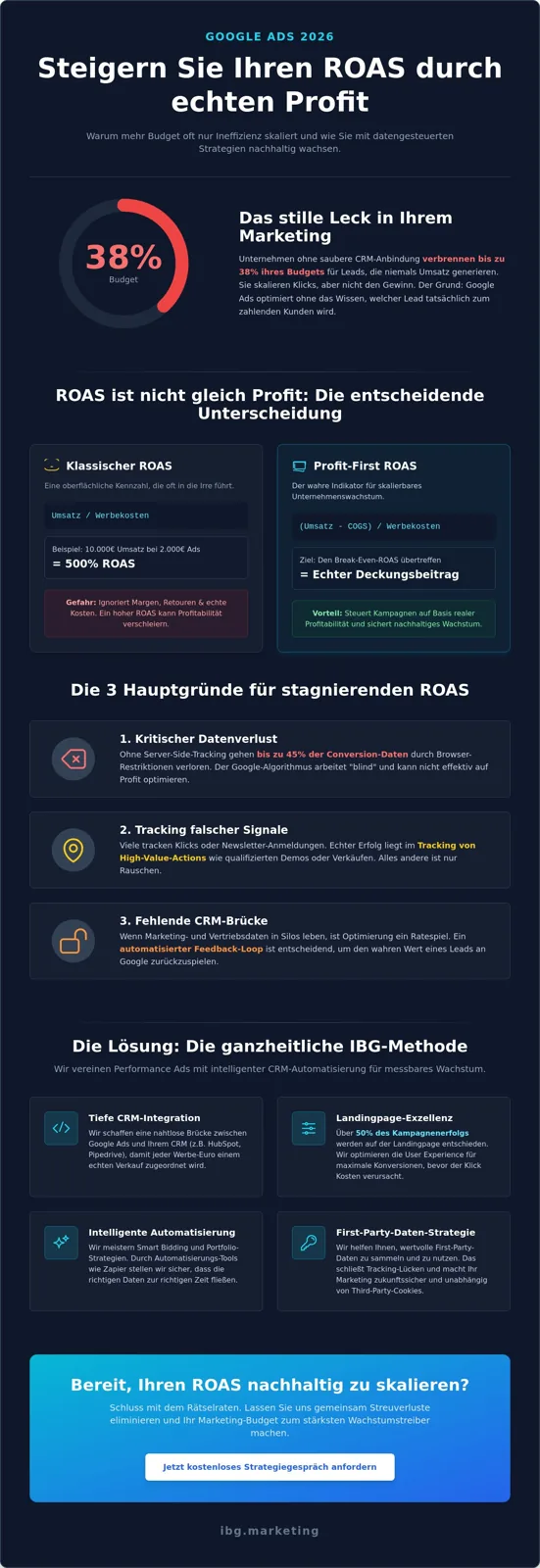
In 2026, more budget does not automatically lead to more profit; more often than not it simply scales your inefficiency. You know the problem: the click numbers go up, but your ROAS stays exactly where it was. If you want to improve google ads roas sustainably, optimising inside the Google interface alone is no longer enough. In our projects here in Munich we see again and again that companies without a clean CRM connection burn up to 38% of their budget on leads that never produce a single cent of revenue.
You finally want clarity about which invested euro actually leads to a real deal. It is frustrating when the data between clicks and money in the bank stays murky. Here is our promise: with the right CRM integration and data-driven strategies, your marketing budget becomes a genuine growth driver. At IBG Marketing we have already walked this path successfully with partners such as Brera and Bridgewave, eliminating wastage step by step.
This guide gives you a crystal-clear roadmap for raising your ROAS. Step by step, we show you how to massively improve the data quality in your CRM, use automated feedback loops and finally scale your campaigns profitably and safely in 2026.
Key Takeaways
• Understand why ROAS is a dangerous vanity metric when it ignores your individual margins, and how to optimise for real profit instead.
• Learn how deep CRM integration and first-party data let you sustainably improve google ads roas and close your tracking gaps in 2026.
• Discover why more than 50% of campaign success is decided outside the Google dashboard, on the landing page, and how to pull that lever actively.
• Master smart bidding and portfolio bid strategies to steer your startup's budget automatically and highly efficiently across different channels.
• Use the holistic IBG method to combine performance ads with intelligent CRM automation for scalable, measurable business growth.
What Is Google Ads ROAS and Why Does It Matter More Than Ever in 2026?
Return on ad spend (ROAS) describes the ratio between the revenue generated by advertising and the advertising costs invested. In 2026 this metric has changed dramatically. It is no longer just an indicator of campaign performance, it is the central steering instrument for profitable growth. In a market where CPCs (costs per click) in Germany have risen by an average of 12.4 percent across all industries, a superficial look at revenue is no longer enough. ROAS is a specific sub-category of return on marketing investment (ROMI), isolating the efficiency of your advertising spend. Anyone who books pure ROAS as a success without accounting for product margins walks straight into the vanity metrics trap. A high ROAS can look brilliant on paper while the company is in fact losing money through high return rates or rising logistics costs in and around Munich. That is why at IBG Marketing we take a holistic view that ties ROAS directly to your business success. To understand this concept better, this short video helps:The Formula for a True Profit-First ROAS
The classic calculation is simple: revenue divided by ad spend. If a campaign generates 10,000 euros in revenue on 2,000 euros of ad spend, the ROAS is 5.0 (or 500%). That is only half the truth, though. For real growth we build variable costs and margins into an extended calculation. Only then do you see the actual profitability after deducting cost of goods sold (COGS) and shipping fees. For startups, the break-even ROAS marks the critical threshold at which every euro invested in Google Ads covers the variable costs and generates a genuine contribution margin. If your actual figure sits below it, every click burns capital instead of scaling your business sustainably.Why Startups Often Fail at ROAS Optimisation
Many teams focus on the wrong signals. They track simple clicks or newsletter sign-ups instead of prioritising high-value actions such as qualified demo bookings or direct sales. Without clean server-side tracking, up to 45 percent of conversion data is lost to browser restrictions in 2026. That makes it impossible to improve google ads roas, because the algorithm is working with "blind" data. Another problem is the attribution window. With complex B2B solutions, decisions often take months. A standard 30-day window falls short here and makes successful campaigns look unprofitable. On top of that, the technical bridge between marketing data and the sales CRM is often missing. If Google Ads does not know which lead actually became a paying customer, every optimisation stays a guessing game. We solve that with automated workflows using Zapier or GoHighLevelTechnical Foundations: Improve Your Google Ads ROAS Through CRM Integration
If you want to improve google ads roas, you have to understand one thing in 2026: data is the fuel of AI. Without clean first-party data, every bid strategy stays patchwork. The days when a simple pixel was enough are definitively over. In a world without third-party cookies, your own database is your most valuable asset.
At IBG Marketing in Munich we see every day that technical excellence makes the difference between scaling and stagnation. Future-proof setups rely on profit-focused advertising strategies that map the entire sales funnel. A deep integration of HubSpot makes it possible to feed real sales data back to Google. That way the algorithm learns not only who clicks, but who actually buys.
There are often data gaps between different tools. This is where Zapier comes in. It acts as a bridge, closes gaps in real time and feeds Google's AI with high-quality signals. The result is more precise targeting and a significantly more efficient use of budget.
Enhanced Conversions and Offline Conversion Tracking
Enhanced conversions are the standard for precise tracking in 2026. By hashing user data such as email addresses or phone numbers, you make sure conversions are still attributed when cookies fail. Setup takes three steps: activation in the Google Ads account, adjustment of the tag setup and validation of the data quality in the interface.
For lead-gen startups in particular, offline conversion tracking (OCT) is the decisive lever. Counting contact requests is not enough. You have to measure sales qualified leads (SQLs). By connecting Pipedrive we capture the actual customer lifetime value. That lets us optimise bids on the basis of the real contribution margin instead of CPL alone.
Server-Side Tracking as the Standard for 2026
Client-side tracking is hitting its limits. Ad blockers and browser restrictions now filter out 20% to 30% of the relevant data. That artificially pushes your ROAS down. Server-side tagging gets around these hurdles by sending the data to your own server first and to Google afterwards. It massively improves your control over your data.
Alongside precision, GDPR compliance plays a central role. A server-side setup acts as a control instance. You decide which data points get anonymised or filtered before they leave the EU. For German companies, this level of data protection is an anchor of trust when winning customers. We have already implemented this system successfully with partners such as Bridgewave, so they can improve google ads roas while staying on the right side of the law.
Would you like to know how much potential is going unused in your current tracking setup? Let us analyse your data strategy together.
Strategic Levers for Maximising Return on Ad Spend
If you want to improve google ads roas, you cannot just turn the bidding dials inside the Google Ads interface. Real leverage comes from the interplay of technical precision and psychological relevance. One decisive factor remains the Quality Score. A score of 9 or 10 cuts your click prices by up to 50% compared to the market average. Put the other way round: on the same budget you double your reach and slash your customer acquisition costs (CAC).
Often, though, the reason for weak performance is not in the campaign setup at all. Data analyses from the first quarter of 2026 show that roughly 50% of ROAS problems trace back to poor landing pages. If the page takes longer than 2.5 seconds to load, or does not deliver on the promise of the ad immediately, users bounce. In Munich we look after clients such as Brera, where we stabilise ROAS through targeted conversion rate optimisation (CRO) before we scale the media budget. The point is to prioritise high-intent keywords. A user searching for "buy automation software" is worth more than 100 users who only type "what is automation".
Creative Strategy: Ads That Convert
In 2026, creatives win the battle for attention. We rely on consistent A/B testing of headlines and visuals built on psychological triggers such as scarcity or social proof. Static ads are often no longer enough. Video ads for YouTube and the display network strengthen your brand as early as the awareness phase. Personalisation is decisive. A user in the retargeting phase needs different arguments than someone seeing your brand for the first time. Short, sharp messages beat complex explanations every time.
WhatsApp as a ROAS Booster in the Sales Funnel
One often underestimated lever for raising profitability is direct communication after the click. WhatsApp Marketing has proven to be a game changer. By integrating WhatsApp funnels into your Google Ads strategy you can raise the conversion rate by up to 30%. Instead of letting leads go stale in cold email inboxes, the conversation happens where your customers already communicate.
With tools such as Brevo we automate follow-ups and make sure no lead is lost. This immediate response time is a massive competitive advantage. For scalable customer relationships, professional WhatsApp marketing campaigns are indispensable today. They turn expensively bought traffic into loyal repeat customers and help you improve google ads roas for the long run.
Automation and Bid Strategies for Scalable Growth
In 2026, automation is no longer an optional feature, it is the foundation for anyone who wants to improve google ads roas. The key lies in the controlled use of smart bidding. For startups with a monthly budget of 5,000 euros and up, the target ROAS (tROAS) strategy is usually the most efficient choice. It uses real-time signals such as location, device type and time of day to adjust bids within milliseconds. With our clients in Munich we often see that a switch to portfolio bid strategies makes the decisive difference. Budgets are shared across several campaigns, which lets the algorithm learn faster and prevents budget silos.
Efficiency also means eliminating waste consistently. Statistics show that without strict exclusion lists, up to 22% of the budget drains away into irrelevant mobile app placements or low-quality display networks. In 2026 we increasingly rely on AI-supported tools that predict lead quality. These tools assess the probability of a deal before the bid is even placed. That way your capital only flows into clicks with real business value.
Steering Performance Max (PMax) Campaigns Properly
PMax is often criticised as a black box, yet with the right signals it becomes a profitability machine. The algorithm needs high-quality data to understand who your ideal customers are. Upload first-party data from your CRM to give the system a head start. For asset groups the rule is: quality beats quantity. One high-resolution video performs better in 2026 than ten mediocre stock photos. A critical mistake many agencies make is including brand traffic in PMax. It pushes ROAS up artificially but generates no incremental growth. Exclude your brand keywords consistently so you can measure the true performance of your new customer acquisition.
Data Analysis and Dashboards for Full Transparency
Transparency is the basis of any scaling. Without a central marketing dashboard for monitoring your metrics in real time, you make decisions while flying blind. In 2026 the data-driven attribution model is the only logical standard. It distributes the value of a conversion dynamically across all touchpoints and replaces outdated models such as last click. Only then do you see what role a display ad at the start of the customer journey really plays.
Use strategic marketing KPIs to steer not just the click rate but your entire marketing mix. Once you understand how Google Ads interacts with your WhatsApp marketing or your CRM, you can improve google ads roas and raise customer lifetime value at the same time. We help you translate these complex data streams into clear instructions for action.
Do you want to take your bid strategies to the next level? Let us analyse your Google Ads performance for 2026 together.
The IBG Method: How We Scale ROAS for Agile Startups
Successful scaling in 2026 takes more than a well-configured ad account. At IBG Marketing we follow a holistic approach that links performance ads seamlessly with CRM systems and intelligent automation. We do not look at Google Ads in isolation, but as part of a profitable ecosystem. Our team in Munich combines the local proximity you need with global growth strategies to give startups a real competitive edge.
We clearly distance ourselves from the outdated "set and forget" mentality. Anyone who wants to improve google ads roas has to live agility. That means daily data analysis and fast adjustments to market changes. Our success stories with clients such as Brera and Bridgewave prove that this method works. There we showed that the right interlocking of technology and strategy makes double-digit growth rates possible while efficiency keeps rising.
From Setup to Scaling: Our Process
Our process is built for speed and measurable results. In the first step we run a deep audit of your existing account. Within the first 14 days we identify so-called quick wins, optimisation opportunities that free up capital immediately. Once the foundation is in place, we roll out the technological infrastructure.
• Seamless implementation of HubSpot to close the data gap between lead and closed deal.
• Automation of data flows via Zapier to eliminate manual sources of error.
• Connection of first-party data to Google Ads for more precise smart bidding.
After the technical setup we move into iterative test cycles. We continuously test new creatives, landing page variants and bid strategies. This data-driven rhythm makes sure we improve google ads roas and invest the budget where it delivers the highest marginal return. We do not rely on gut feeling, we rely on hard facts from your CRM.
Your Next Step Towards Profitable Growth
The digital advertising market of 2026 no longer forgives inefficiency. Startups that fail to adopt an automated, data-based strategy now lose valuable market share to more agile competitors. A change of strategy is not a risk, it is the necessary insurance for your future growth. It is time to take back control of your acquisition costs.
We invite qualified startups with 5 to 15 employees to a free strategy call. In that call we analyse your current setup and show you concrete levers for scaling. Let us take your Google Ads ROAS to the next level together in 2026. Book your appointment here.
Meta Description: Find out how to improve your Google Ads ROAS. IBG Marketing combines CRM, ads and automation for your growth. Book your strategy call now!
Your Roadmap to Measurable Growth and Maximum Efficiency
The advertising market of 2026 no longer forgives imprecise data. Anyone who wants to improve google ads roas sustainably has to build a solid bridge between marketing and sales. Through deep CRM integration via HubSpot or Zapier we turn vague clicks into valuable business signals. Our experience with clients such as Brera and Bridgewave proves that agile startups massively increase their efficiency with the IBG method. We feed Google's algorithms with real revenue data instead of superficial metrics.
Your success is no accident, it is the result of a smart, automated system. We at IBG Marketing in Munich help you pull the strategic levers for profitable growth consistently. It is time to turn your performance marketing from a cost centre into a scalable revenue machine. We accompany you on this path with expertise and passion, so your startup can back up its next funding round with excellent numbers. Let us get started together.
Book a free strategy call now.
Frequently Asked Questions About ROAS Optimisation
What is a good ROAS on Google Ads in 2026?
In 2026, a profitable ROAS for most e-commerce companies sits between 400% and 600%. Agile startups often start out at around 300%, while established brands in Munich need higher margins for sustainable growth. With partners such as Brera we analyse the individual gross margins in order to set exact targets for scaling.
How long does it take for ROAS optimisation to show results?
You usually see the first significant results after 14 to 21 days. Google needs this period to train its algorithms reliably on the new data structures and signals. Patience is decisive in this phase if you want to improve google ads roas without interrupting the learning phase through hectic manual changes.
Can I improve ROAS on small budgets too?
Yes, improvement is possible from budgets of 1,500 euros per month upwards through radical focus. Instead of spreading the budget across 50 products, we concentrate on the top three performers with the highest margin. This concentration of data helps the smart bidding algorithms learn faster and improve google ads roas.
What role does the landing page play for ROAS?
The landing page is the most important lever outside the Google Ads account. Lifting the conversion rate from 2% to 3% improves your ROAS immediately by 50% at unchanged click costs. For this we use targeted conversion optimisation to make sure the expensively bought traffic really does convert into revenue.
Should I always bid on target ROAS?
No, the target ROAS (tROAS) bid strategy only makes sense from roughly 30 to 50 conversions per month within a campaign. Without that data basis the algorithm acts blindly and restricts reach far too much. We recommend switching only after a stable performance phase, which we often track precisely through tools like HubSpot or Zapier.
How does WhatsApp marketing influence my Google Ads ROAS?
WhatsApp marketing acts as a massive performance turbo by raising customer lifetime value (CLV). By integrating automated funnels via WhatsApp Marketing we turn one-time visitors into loyal repeat customers. Data from our projects shows that the repeat purchase rate rises by 25% through this direct channel, which drastically increases the overall efficiency of your Google Ads campaigns.
Turn this into results.
Branding, lead generation and done-for-you funnels, engineered with AI, live in weeks.
Book a free callChat on WhatsAppKeep reading

How to Set Up Automated Lead Rotation in HubSpot 2026: The Ultimate Guide
Set up automated lead rotation in HubSpot for 2026: cut response times, distribute leads fairly, and scale your sales team without
Read · 13 min →
Generating B2B Leads With Google Ads 2026: Strategies for Scaled Growth
Learn how to generate B2B leads with Google Ads in 2026: precise targeting, CRM automation with HubSpot and Zapier, and WhatsApp f
Read · 16 min →
CRM Implementation Checklist 2026: The Ultimate Guide for Agile Startups
Skip the costly CRM mistakes. This 2026 implementation checklist walks agile startups through strategy, data migration, and change
Read · 15 min →