
Google Ads Agency Cost 2026: What Startups Must Invest for Real Growth

Why do 42% of German startups, according to 2025 market data, burn a significant share of their budget on campaigns that deliver clicks but no real profit? You probably know yourself that Google Ads is the most effective route to scaling, yet the often opaque google ads agency cost feels like a black box with no clear proof of ROI. It is exhausting when agencies charge high fees without the leads they generate being cleanly documented in your HubSpot CRM.
In this guide you will learn everything about fair pricing models, hidden fees and how to get the maximum return from your budget in 2026. At IBG Marketing in Munich we do not treat ads as an isolated expense but as a strategic investment in your growth. We give you a transparent overview of today's cost landscape and show you how to find a partner who puts measurable sales above mere impressions. Get ready to put your scaling on a data-driven foundation that delivers real results.
Key Takeaways
• Understand the essential separation between direct media spend and the agency retainer so you can plan your 2026 budget precisely and transparently.
• Find out which google ads agency cost models really scale for startups, from the planning security of a fixed fee to a motivating performance fee.
• See why cheap "set and forget" approaches burn your budget and how professional optimisation pays into valuable leads instead of worthless clicks.
• Learn how to maximise your ROI by integrating CRM data and full-funnel tracking, and how to use first-party data for pinpoint retargeting.
• Discover the IBG approach from Munich, which replaces rigid standard packages with tailored growth strategies and takes your startup forward as a true partner.
Understanding the cost structure of a Google Ads agency in 2026
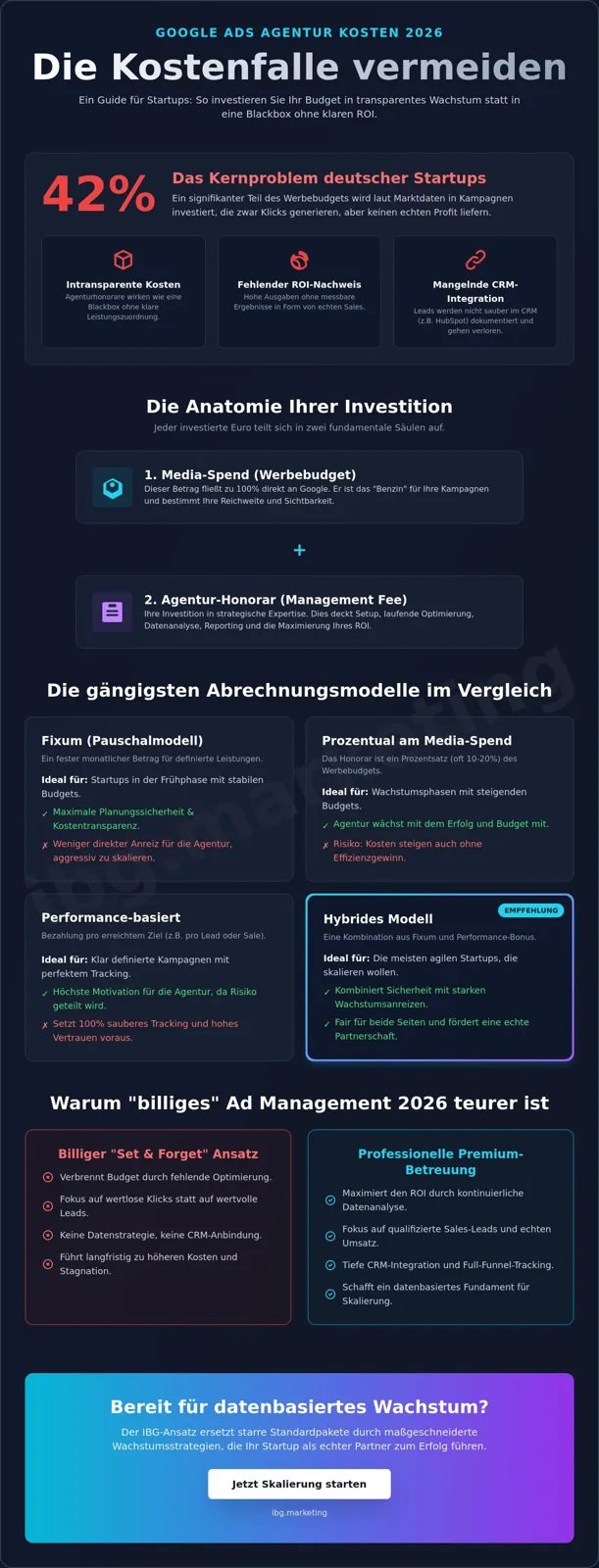
Any startup in Munich or beyond that wants to scale in 2026 has to see the google ads agency cost as a strategic investment. It has long stopped being about simply running ads. Today the cost structure splits into two fundamental pillars: media spend, which flows directly to Google as budget, and the management retainer for the agency's operational and strategic expertise. Your choice among the common billing models largely decides how transparent and scalable your campaigns will be.
This video helps you understand how these costs come together:
In 2026 the setup fee is far more than simply opening an account. Complexity has risen sharply because of AI-driven campaign types such as Performance Max (PMax) and the need for first-party data. A modern setup now always includes a thorough data strategy. According to market observations, tracking errors lead startups to burn up to 35% of their budget on irrelevant clicks. That is why the technical tracking setup often takes up the largest part of the initial cost. Whether you advertise only on Search or pursue complex multi-channel strategies across Display and YouTube has a direct effect on the workload.
One-off setup fees vs. monthly management
A professional audit stands at the start of every collaboration. We analyse existing structures and eliminate inefficiencies. That is followed by the basic technical configuration, which in 2026 is impossible without a clean HubSpot CRM implementation
Common billing models: from fixed fee to performance fee
Startups in Munich need clarity. Anyone scaling in 2026 cannot afford to carry hidden costs along. The google ads agency cost depends heavily on the model you choose. Every startup has different cash-flow needs and growth targets.
The flat-rate model (fixed fee) offers maximum planning security. You pay a set amount each month. It is ideal for teams with stable budgets and clear goals. The agency delivers the agreed scope, regardless of exactly how much work a single week takes.
With a percentage share of the ad budget, costs rise as you grow. This usually sits between 10 and 20 percent of ad spend. That is fair as long as performance holds up. It becomes critical when you scale heavily without gaining efficiency. Here, maximising ROI through CRM integration helps you validate the real value of every euro invested.
Performance-based models share the risk. The agency only earns when you achieve measurable results. However, this requires absolutely clean tracking and a high level of mutual trust. Often a hybrid model is the best route. A moderate base fee covers the core workload, while bonuses for hitting KPIs create real growth incentives on both sides.
Comparing pricing models for agile startups
| Model | Best suited for | Cost transparency | Scalability |
|---|---|---|---|
| Fixed fee | Early stage | Very high | Medium |
| Percentage | Growth stage | Medium | Very high |
| Hybrid | Established startups | High | Optimal |
Hybrid models are gaining importance in 2026. They combine security with a hunger for results. Transparency is everything here, especially when billing for Meta Ads Management. Data has to flow so that decisions rest on facts rather than gut feeling.
How to spot a fair agency offer
A fair offer does without lock-in contracts. Look for short notice periods of 1 to 3 months. A detailed scope of services is mandatory so you know exactly what you are paying for.
Data ownership
The Google Ads account always belongs to you, never to the agency.
Direct access
You keep full visibility into all campaign data and bidding strategies.
No "all-inclusive" without evidence
Insist on regular reporting and detailed time records.
Be careful with offers that behave like a black box. Professional partners like us at IBG Marketing rely on radical openness. Only those who know their numbers can grow profitably. Let us review your current fee structure.
Why cheap ad management costs more in 2026 than premium support
Anyone who looks only at the smallest price tag when weighing up the google ads agency cost often walks into an expensive growth trap. Cheap agencies usually finance their low flat rates through volume instead of quality. That inevitably leads to the dangerous "set and forget" principle. Campaigns are set up once and barely optimised afterwards. In a dynamic market like Munich, however, standing still means losing budget outright. Without daily bid adjustments and the exclusion of irrelevant search terms, a startup burns on average 30 to 40 percent of its budget on clicks that will never convert.
The Harvard Business Review warns that the effectiveness of digital advertising is often massively overestimated when it is not steered precisely. This is exactly where premium support comes in. While budget providers optimise for raw click numbers, we focus on lead quality and actual contribution margin. A click for 1.50 euros is worthless if there is no intent to buy. A lead for 50 euros, on the other hand, is worth gold if it promises a customer lifetime value of 5,000 euros.
A real-world example: one SaaS startup lost more than 6,500 euros within a single month because of a misconfigured automated bidding strategy. The agency had set "maximise conversions" without checking data quality. Google then optimised towards worthless newsletter sign-ups instead of real demo bookings. Only senior expertise and a manual correction of the signals brought the CPA (cost per acquisition) down by 62 percent.
The role of AI and automation in pricing
In 2026 AI is no longer a bonus but a basic requirement. The difference lies in how it is applied. Cheap agencies use AI to avoid work. We use it to multiply results. With Zapier process automation we eliminate manual data transfers and error-prone reporting tasks. That lowers our operational costs, which we invest directly into strategic analysis time. Instead of simple standard reports, our clients receive in-depth insights that show why certain cohorts perform better than others. AI supplies the data, but our experts make the business decisions.
Avoiding growing pains: scaling without losing efficiency
When a startup scales, the demands rise exponentially. A budget of 2,000 euros is still easy to manage. At 20,000 or 50,000 euros a month, the smallest mistakes cause massive losses. We build specific Marketing KPIs 2026 directly into how the agency is steered, to make sure efficiency stays stable as spend increases. Our experience with demanding clients such as Brera and Bridgewave shows that real scaling only works through deep integration of CRM data and ad platforms. Save on management here and you will pay the difference back to Google twice over later.
Maximising ROI through CRM integration and automation
In 2026, startups in Munich and across Germany face a hard reality: rising click prices eat into margins when lead quality stagnates. Anyone still running isolated campaigns without deep data integration is burning capital. Real scaling only emerges when marketing and sales merge technologically. When you calculate the google ads agency cost for your 2026 budget, you have to price in the lever of automation from the start.
We follow a four-step process to squeeze the maximum profit out of every euro of ad spend:
Step 1: full-funnel tracking.
We track the path from the first ad to "closed won" status in your CRM. Only then can you see which campaigns really generate revenue instead of merely delivering cheap clicks.
Step 2: first-party data.
Use your own customer data for precise retargeting. In a post-cookie era this data is your most valuable possession for building highly relevant lookalike audiences.
Step 3: automated lead qualification.
With intelligent workflows we filter out unsuitable enquiries immediately. Your sales team focuses exclusively on the 20% of leads that account for 80% of your future revenue.
Step 4: continuous feedback loops.
We feed sales data from the CRM back to the Google algorithm. The system learns in real time to look specifically for buyers instead of people who merely fill in forms.
HubSpot as the heart of your Google Ads strategy
As a specialised HubSpot agency 2026 we implement systems that go far beyond classic lead generation. Through offline conversion tracking we optimise your Google Ads based on actual cash flow. That means the algorithm is fed with the value of real deals. For investors and management we create automated reports that make the direct link between ad spend and company growth transparent. That builds trust and enables faster budget approvals for scaling.
WhatsApp marketing as a conversion boost
Integrating WhatsApp Marketing 2026 is the most effective way to cut CPL (cost per lead) dramatically. We build direct ads-to-WhatsApp funnels that minimise friction. Leads are captured right inside the chat, supported by GDPR-compliant automation in conversational commerce. Clients such as Bridgewave use these approaches to push response times below 60 seconds. In a market where speed decides who closes the deal, this automation is your decisive edge over the competition.
Maximise your ROI with a setup that does not just collect data but turns it into profit. Let's scale your WhatsApp funnel for 2026 together, get in touch here.
Your partner for scaled growth: Google Ads management at IBG
IBG Marketing is not a classic service provider that merely administers budgets. As Munich-based experts for performance and automation, we see ourselves as an integral part of your team. We know that for startups with 5 to 15 employees every euro counts. That is why we consistently avoid rigid standard packages. Our approach is built on tailored growth strategies that fit your current funding stage and your market goals for 2026 exactly.
Transparent communication is not a marketing buzzword for us, it is the basis of our daily work. Every decision we make is data-driven and traceable for you at any time. We combine high-performing ads with deep integration into your CRM, preferably HubSpot. Through intelligent automation we make sure your leads are not only generated but guided efficiently through the sales funnel. That lowers the effective google ads agency cost in the long run, because your closing rate rises.
Why startups in Munich trust IBG
Funded growth companies such as Brera and Bridgewave rely on our expertise because we speak their language. We think in profit and customer lifetime value, not in meaningless impressions. In Munich's dynamic startup scene we have earned a reputation as a partner who keeps a cool head even under heavy scaling pressure. We optimise your campaigns daily to get the maximum out of your budget.
Focus on ROI
We measure success by your bank account, not by click-through rates.
Local expertise
As an agency in Munich we are close to the trends of the German founder scene.
A holistic view
We look at the entire customer journey, from the first ad to the closed deal in the CRM.
Would you like to know how we can take your startup to the top in 2026? We invite you to a free strategy call. Together we analyse your status quo and show you concrete levers for your Google Ads account.
Next steps for your scaling
Our onboarding process at IBG is lean and efficient. We start with a deep audit of your existing accounts and a competitor analysis. Then we define your Google Ads Management 2026 goals together. In doing so we rely on clear KPIs that make your scaling measurable. Whether it is about lowering cost per acquisition (CPA) or opening up new markets, we deliver the strategic framework.
The road to real growth begins with a well-founded decision. If you see the google ads agency cost not as an expense but as an investment in your market success, we are the right partner for you. Let's take your performance to the next level together.
Meta Title: Google Ads Agency Cost 2026 | IBG Marketing Munich
Meta Description: What does a Google Ads agency cost in 2026 for startups? Learn everything about pricing, ROI and scaling at IBG Marketing. Book your strategy call now!
Your roadmap to profitable Google Ads growth in 2026
Anyone who wants to survive digital competition in 2026 cannot treat marketing as a mere cost centre. The google ads agency cost is the fuel you need for market share and for scaling your business model. Startups such as Brera and Bridgewave have already proven that the combination of precise ad management and deep CRM integration makes the decisive difference in a fiercely contested market.
At IBG Marketing in Munich we consistently focus on measurable performance and full transparency. Through intelligent automation with Zapier and the data power of HubSpot we turn simple clicks into valuable customer relationships. A cheap, standardised setup ends up costing you far more through burned budget and missed growth opportunities.
Choose a strategy built on hard numbers that scales your startup sustainably instead. We accompany you as a strategic partner on equal terms and make sure every euro invested in your funnel works at maximum effect. Your success is not luck, it is the result of a data-driven system.
Let's scale your Google Ads funnel for 2026 together. Book your free strategy call now.
The future of your growth begins with the right decision today.
Meta Title: Google Ads Agency Cost 2026: Startup Growth | IBG
Meta Description: What does a Google Ads agency really cost in 2026? Discover the models for startups and maximise your ROI with IBG. Book your strategy call now!
Frequently asked questions about Google Ads agency costs in 2026
What does a Google Ads agency cost per month on average?
In 2026 a specialised agency charges on average between 1,200 € and 3,500 € as a monthly fixed fee for managing startups. In a competitive market such as Munich, these prices reflect the expertise needed for data-driven scaling. Additional performance fees tied to agreed targets are becoming the standard model for advanced campaigns.
The exact google ads agency cost depends heavily on the scope of management and the number of channels being run. Alongside the fixed fee, companies should expect a setup fee for the initial strategy development. That investment secures access to expert knowledge that goes beyond pure click optimisation and drives genuine business growth.
From what ad budget is hiring an agency worthwhile?
Working with a professional partner makes economic sense from a monthly ad spend of at least 3,000 €. With smaller budgets, management fees would tie up too large a share of your capital, which neutralises the leverage of optimisation. Startups have to make sure the agency fee stays in a healthy ratio to the media budget so that return on ad spend (ROAS) is not artificially depressed.
For companies in the growth stage, this budget is the lower limit for generating enough data to make statistically relevant decisions. Professionals use tools such as Meta or Google to become profitable faster through precise testing. If you invest less, you should handle management internally at first, until you have the traction needed for external scaling.
Are there cost differences between B2B and B2C Google Ads?
B2B campaigns often cause higher management costs because the customer journey is more complex and requires deep integration into CRM systems such as HubSpot or Pipedrive. The focus here is on lead quality rather than pure quantity, which means more manual optimisation work. Audience targeting is sharper, so research and the ongoing exclusion of irrelevant search terms take up more time.
In B2C, by contrast, high transaction volume and the visual presentation of Shopping ads take centre stage. While B2B agencies often provide strategic advice on the lead-nurturing journey, B2C experts concentrate on fast sales and dynamic remarketing. Both models require specific know-how, and the technical complexity of the B2B sector usually justifies a higher monthly flat fee.
Are the costs of the tracking setup included in the management fee?
No, professional tracking implementations such as server-side tracking or Google Consent Mode V2 are usually billed as a separate project in 2026. The complexity of modern privacy requirements makes a clean technical foundation a prerequisite for any campaign success. Without correct data transfer through interfaces such as Zapier, performance measurement stays patchy and leads to expensive wrong decisions.
Agencies charge one-off fees for this onboarding that, depending on the system landscape, can range between 1,500 € and 5,000 €. That investment has no alternative, because only valid data forms the basis for AI-driven bidding strategies. Once in place, these systems enable automated scaling that goes far beyond manual campaign management.
How long should the minimum term of a Google Ads agency contract be?
A contract term of 3 to 6 months is ideal for startups, so that the algorithms' learning phase and the scaling phase that follows can be fully exploited. Short engagements of just four weeks rarely deliver lasting results, because the system needs time to collect conversions. With clients such as Brera and Bridgewave we see that real profitability usually arrives after the first thorough round of optimisation in month two.
Contracts running for a full year do offer planning security, but they can be too rigid for agile startups. A model with an initial phase of three months followed by a short notice period combines security with flexibility. It also forces the agency to convince you month after month with measurable results.
Why do agencies often charge a percentage of the ad budget?
The percentage model reflects the rising workload that inevitably comes with bigger budgets and more complex account structures. When a startup doubles its budget, the number of campaigns, creatives and necessary risk-management checks grows proportionally. This model makes sure the agency provides the resources needed to maintain maximum efficiency even at high spend.
It also gives the agency an incentive to increase the budget only when performance justifies it. In practice this share usually sits between 10 and 20 percent of media spend in 2026. It is a fair solution that ties the client's growth directly to the provider's success and encourages a genuine partnership on equal terms.
Turn this into results.
Branding, lead generation and done-for-you funnels, engineered with AI, live in weeks.
Book a free callChat on WhatsAppKeep reading

How to Set Up Automated Lead Rotation in HubSpot 2026: The Ultimate Guide
Set up automated lead rotation in HubSpot for 2026: cut response times, distribute leads fairly, and scale your sales team without
Read · 13 min →
Generating B2B Leads With Google Ads 2026: Strategies for Scaled Growth
Learn how to generate B2B leads with Google Ads in 2026: precise targeting, CRM automation with HubSpot and Zapier, and WhatsApp f
Read · 16 min →
CRM Implementation Checklist 2026: The Ultimate Guide for Agile Startups
Skip the costly CRM mistakes. This 2026 implementation checklist walks agile startups through strategy, data migration, and change
Read · 15 min →